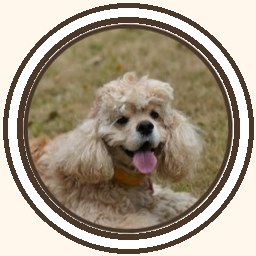
What one photo of your dog can and cannot tell you
A still frame carries four of the signals that matter and drops three others. Knowing which is which is most of what separates a useful read from a confident wrong one.
Plenty of tools now offer to read your dog's stress from a single photo. The claim is not absurd — a still frame genuinely carries a lot. But it drops things too, and the drops are where confident misreadings come from.
What a still frame carries
Ear position. Forward and loose, or pinned flat back, or held out sideways. Ears are close to involuntary and they resolve well in a photo.
Eye shape. Whether the whole eye is soft and relaxed, or the whites are showing at the side because the head is held still and only the eyes have moved away. That second one is one of the clearest "please stop" signals a dog has, and it photographs cleanly.
Tail height and stiffness. Where the tail sits relative to the spine, and whether it is held rigid.
Weight distribution. Whether the dog is leaning in, standing even, or has shifted its weight onto the back legs. This is the single most underrated thing in a photo, and it is usually the difference between a dog enjoying contact and a dog tolerating it.
Four real signals. That is enough to be useful.
What it drops
Motion. A photograph freezes a wag into a tail angle, and the angle is not the information. The quality of the movement is — a low wide sweep and a high stiff tail with only the tip flicking mean close to opposite things, and a still frame can render both as "tail up and to the left". This is the biggest single loss.
Duration. A dog can hold a tense posture for a quarter of a second while a door opens. The photo cannot distinguish that from the same posture held for a minute, and only one of them says something about how the dog is doing.
Context. What is outside the frame is often the whole explanation. A dog with pinned ears next to a vacuum cleaner has been explained. The same dog with pinned ears in an empty room has not.
Which photos are not readable
Some images cannot be read at all, and it is worth knowing which before you conclude anything from a reading of one.
Too dark for pupil size to mean anything. Cropped to the head, so the tail and the weight are gone. Motion-blurred. Taken face-on, where the tail is hidden behind the body. Any of these leaves two or three of the four signals missing, and a reading built on what remains is a guess wearing a number.
If a reading comes back confident anyway, you have learned something — about the product, not the dog.
The thing a photo cannot give you at all
Whether this is normal for your dog.
Some dogs carry their ears half-back all the time. Some hold their tails low as a resting state. A reading that says "slightly anxious" may be describing a dog that has looked exactly that way for nine years, in which case it has described nothing.
This is why a single photo, however well read, is the weaker half of the method. The stronger half is a dated series — same time, same spot, once a day for a week or two. What you are looking for is not the reading. It is the departure from the readings before it.
How we handle it
We build Hachimo, which reads those four cues from a photo or a short clip. We have a stake in this, so weigh the next two paragraphs accordingly.
Two consequences of the above are built in. Images that are too dark or too cropped come back as "not enough to go on" rather than as a mood, because a reading off two visible cues is not worth the confidence it would project. And readings are saved, so the comparison against your own animal's baseline is possible rather than theoretical.
Neither is a clever feature. They are what falls out of taking the limits of a single frame seriously.
Made with 💛 and many head scratches. Hachimo is for fun and curiosity — it's not veterinary advice. If your pet seems unwell, please talk to a real-life vet. 🩺